
Introduction
One of the threats which has gained serious attention in the business world is ransomware attacks. These new attacks tend to avoid the conventional methods of security. In this regard, organisations are now turning to Artificial Intelligence (AI) in order to have greater security. The use of AI is more useful in identifying and reacting to ransomware faster and without human intervention. It can also identify suspicious patterns which cannot be identified by humans. In fact, the existing AI-powered cybersecurity solutions can detect ransomware in under 60 seconds. Due to this, this technology is transforming the way organisations secure their important information and infrastructure. The significant security solutions like Qualysec Technologies go a step further by integrating AI with the capabilities of penetration testing to make sure that it identifies the vulnerabilities before attackers can exploit them.
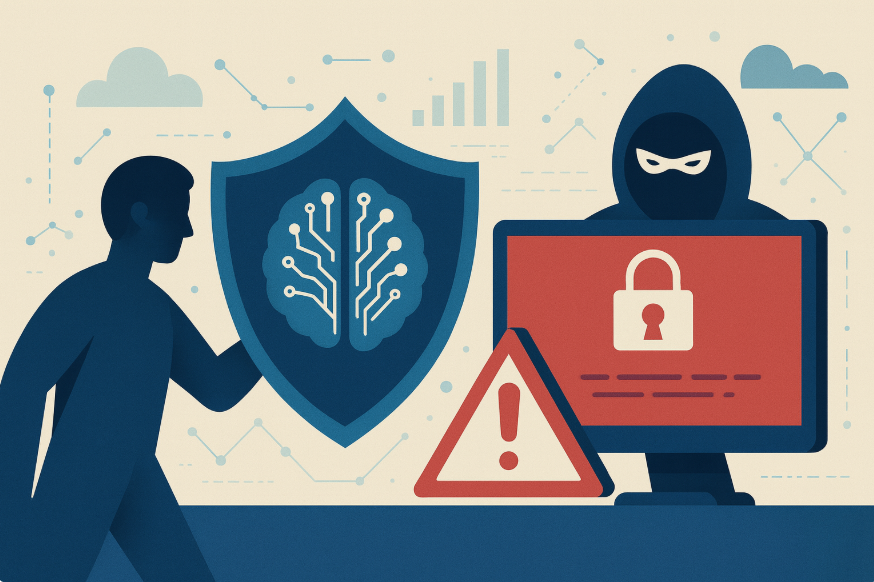
How Does AI Detect Ransomware Faster Than Traditional Methods?
The conventional antivirus programs are based on signature detection. This technique is however not able to detect new or altered ransomware. On the contrary, behavioural analysis is utilised by AI to detect threats. In addition, machine learning models interpret large volumes of data to identify patterns of attacks.
AI monitors several key indicators:
- Abnormal file encoding transactions in real-time.
- Premature system behaviour before attacks increases.
- The network traffic patterns are suspicious.
- Attempts to access sensitive files are unauthorised.
Also, AI constantly tracks the statistics of any single I/O on the basis of machine learning models to identify anomalies such as ransomware within a minute. This is important since the speed will reduce the loss of data due to late detection. Additionally, AI-based endpoint protection software can prevent ransomware operations before they start to encrypt them. Therefore, organisations are able to prevent attacks before they lead to devastation.
As per the recent industry statistics, 64% of CISOs affirm that delaying security upgrades resulted in a successful breach or attack. Hence, AI-based security has become a necessity for contemporary businesses. Companies collaborating with skilled penetration testing companies such as Qualysec are capable of integrating AI scanning with pervasive security evaluations to develop more resistant defences throughout their whole infrastructure.
Why Is Behavioural Analysis Better for Ransomware Prevention?
Behavioural analysis analyses the action of malware and does not consider its appearance. It can thus identify zero-day attacks which are not identified by traditional systems. AI is used to analyse system processes to identify anomalies.
Key Behavioural Indicators AI Monitors:
| Indicator Type | What AI Detects | Response Action |
| File Activity | Rapid encryption of multiple files | Immediate isolation |
| Network Traffic | Unusual data transfers to external servers | Block communications |
| User Behavior | Abnormal access patterns | Trigger alerts |
| System Processes | Unauthorized modifications | Quarantine systems |
Furthermore, AI uses machine learning to monitor data patterns, looking for anomalous behaviours indicative of a cyber threat, and can distinguish ransomware from normal behaviour. This capability dramatically improves threat detection accuracy. Additionally, AI reduces false positives that often overwhelm security teams.
There are major benefits to organisations that employ AI-enhanced security. Indicatively, they attain a quicker time of incident response and enhanced resource distribution. In addition, end-to-end cybersecurity products offered by Qualysec offer multifaceted security against emerging threats. Having more than 1000 assessments done in 30 or so countries and a record of zero data breaches, Qualysec provides proof of how AI technology, when used together with professional security assessment, can build up a strong defence mechanism. Their hacker-style approach replicates the real-life attacks to identify any weakness that automated tools may fail to detect.
Can AI Stop Ransomware After an Attack Begins?
Yes, AI-enabled systems may still have ransomware even when the infection has begun. Response systems are automated, and they act automatically to reduce damage. Thus, organisations will be able to recover faster in case of attacks.
SOAR is an AI-based Security Orchestration, Automation and Response tools that execute several essential functions:
- Instantly quarantine infected devices
- Prevent malware transfers in networks.
- Transform into automated file recovery operations.
- Barricade command-and-control communications.
Additionally, automated malware filtering, link inspection, and DNS inspection are technical controls which are useful in detecting and preventing malicious activities. Such systems make real-time decisions regarding the risks of an activity. They, therefore, block the horizontal movement of ransomware over the networks.
Studies indicate that 31per cent fewer cases of data security incidents are detected in organisations where the security platforms are streamlined, and 82per cent of security leaders say that a holistic platform is better than single-use tools. Therefore, combined AI technologies are more protective.
Also, organisations must have a strong incident response plan to ensure that AI is used to its fullest. These advanced defences can be applied appropriately by expert security staff such as Qualysec. They give reports in detail, containing technical informational reports and executive reports to all the stakeholders. Moreover, their skills and experience can help development teams address discovered weaknesses, consult them during calls and support them regularly.
Read more: The Benefits of Using Identity and Access Management Tools for Your Business
What Role Does AI Play in Email and Network Security?
Ransomware attacks are mainly targeted at email. Thus, AI-based email security is important to prevent. AI identifies sender behaviour and the content of the message to identify threats.
Email security features include:
- The identification of phishing links and malicious attachments.
- Social engineering technique analysis.
- Determination of impersonation efforts.
- Suspicious content natural language processing.
Moreover, AI tracks network traffic around the clock to detect ransomware. It identifies non-normal data transfers that are indicators of a possible exfiltration. Additionally, AI detects unexpected increases in the encryption operations on the network.
Network security benefits include:
- Blocking access to URLs of malicious sites.
- Preventing pre-encryption data theft.
- Detection of command-and-control servers’ communications.
- Suspicious IP addresses monitoring.
IBM threat intelligence research reveals that AI promotes the rapid detection and reaction to threats considerably. Companies are able to act quickly and continue business when attacked. Moreover, autonomous responses help to reduce the effects of the attacks on business.
BDO’s cybersecurity insights found that automation can help organisations to be more resilient. Firms that use AI-based defenses declare a large amount of savings and enhanced security postures.
Nevertheless, AI is not sufficient to stay totally safe. Companies should integrate AI and powerful policies and educate the staff. There are common backups and multi-layered system security, which are vital parts. Moreover, Qualysec provides professional cybersecurity materials that assist teams in keeping informed about new threats. Their extensive manuals, such as the First-Time Penetration Testing Buyer Guide and sample reports, are a good source of information to enhance security posture. Qualysec has been used by various industries in fintech, healthcare, e-commerce, and SaaS, and each industry has a different security need that is specialised in testing.
Conclusion
AI has transformed ransomware protection for organisations all over the world. It offers quicker recognition, automatic reactions and monitoring. In addition, AI changes to new threats without the need to constantly update the system manually. Those companies that use AI-based security minimise the likelihood of ransomware considerably. Nonetheless, to be successful, AI should be used with an extensive set of security measures. Thus, companies need to invest in combined platforms and professional advice from reputable organisations such as Qualysec Technologies. Organisations can have comprehensive security tests with their process-based testing method, which entails the integration of both manual and automated methods. Their intensive penetration testing extends beyond the normal scan of tools to expound on the functionality and technologies. Finally, AI is the future of successful ransomware protection when used in combination with professional security verification.
FAQ
Can AI completely eliminate ransomware threats?
AI can minimise the risks of ransomware, but it is not able to eliminate it completely because cybercriminals are constantly inventing new ways of attack.
How much does AI-powered ransomware protection cost?
The prices depend on the size and needs of organisations, but now there are numerous cloud-based AI security solutions available to small and medium businesses at reasonable prices.Does implementing AI security require specialised technical expertise?
Although the majority of tasks are automated by the AI, it is recommended that companies collaborate with cybersecurity specialists to implement them appropriately and manage them.